Speaker
Mrs
Indu Bala
(Inter University Accelerator Centre, New Delhi, India)
Description
In the mass region A ~ 60-80, nuclei excited by heavy-ion induced nuclear reactions have revealed a variety of excitation modes, which so far cannot be explained completely in a single theoretical nuclear model. Describing the collective phenomena for the less deformed Zn isotopes with vibrational modes which for the heavier, more deformed nuclei Se and Kr converts into a rotational description. Starting from 56Ni as a closed core, deformation increases with the addition of proton and/or neutron pairs [1]. In this mass region, 1g 9/2 (high angular momentum intruder) orbital plays a significant role among the degree of freedom exited in the states of high angular momentum [2]. The aim of present investigation is to provide detailed information on excited states of 66Zn nucleus, and of course to understand the microscopic and macroscopic structure of the same.
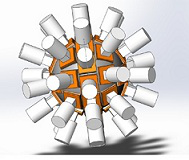
Excited states of 66Zn nucleus have been investigated using the reaction 56Fe( 12C,2p) 66Zn at an incident beam energy of 62 MeV using the Indian National Gamma Array (INGA) [3] performed at Tata Institute of Fundamental Research (TIFR), Mumbai. INGA at the time of experiment consisted of fifteen Compton suppressed clover detectors arranged in six different angles [40o (2), 65o (2), 90o (4), 115o (2), 140o (2) and 157o (3)] with respect to beam direction. Symmetric and angle dependent Eγ - Eγ matrices were made using MultipARameter time-stamped based COincidence Search program (MARCOS) developed at TIFR, with the 100ns coincidence time window and the matrices were analyzed using the analysis software RADWARE [4] and in-house developed Collection and Analysis of Nuclear Data using Linux nEtwork (CANDLE) software [5].
| Summary | The level scheme of 66Zn has been extended both for low and high spin states with the observation of 20 new gamma transitions based γ - γ co-incidence and intensity measurement. The directional correlation and polarization measurements have been performed to assign spin and parity for levels of high intensity reported transitions. The microscopic origin of the investigated band structures is discussed in the context of large shell model calculations in fpg model space using jj44bpn effective interaction. Further, the Total Routhian Surface(TRS) calculations have also been carried out which suggests oblate deformation at low spins and in addition to this at high spins, the co-existance of different nuclear deformations is also suggested. REFERENCES [1] L. Cleemann et. al. Nuclear Physics A386 (1982) 367- 380. [2] G. F. Neal et. al. Nuclear Physics A280 (1977) 161-179. [3] R. Palit, S. Saha, J. Sethi, T. Trivedi, et. al., Nucl. Instr. Meth. Phys. Res. A 680, 90 (2012) [4] D. C. Radford, Nucl. Instr. Meth. Phys. Res. A 361,306 (1995) [5] B. P. Ajith Kumar, E. T. Subramaniam et.al. in Proceedings of theSymposium Advances Nuclear Allied Instrumentation India, 51 (1997) |
|---|
Primary authors
Mrs
Indu Bala
(Inter University Accelerator Centre, New Delhi, India)
Dr
R. P. Singh
(Inter University Accelerator Centre, New Delhi, India)
Dr
S. Muralithar
(Inter University Accelerator Centre, New Delhi, India)
Co-authors
Dr
Anukul Dhal
(Variable Energy Cyclotron Centre, 1/AF Bidhan Nagar, Kolkata, India)
Dr
J. Sethi
(Tata Institute of Fundamental Research, Mumbai, India)
Dr
M. Kumar Raju
(Research Center for Nuclear Physics, Osaka University, Osaka-5670047, Japan)
Prof.
R. Palit
(Tata Institute of Fundamental Research, Mumbai, India)
Dr
S. Saha
(Tata Institute of Fundamental Research, Mumbai, India)
Dr
T. Trivedi T. Trivedi
(Guru Ghasidas Vishwavidyalaya, Bilaspur, India)