Speakers
Mr
Bhushan Bhujang
(PhD student)Mr
Virendra Kumar Pasi
(IIT Bombay)
Description
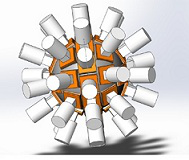
Many doubly odd nuclei in the mass region ~130 have been studied earlier for the phenomena of signature splitting, signature inversion and Chirality e. g. 126I [1], and 128I was also a good candidate. However, being close to β-stability line, it was difficult to populate 128I via compound nuclear reaction. In our preliminary investigations, we observed a good cross section ~ 80 mb [2] of incomplete fusion reaction 124Sn (11B, α3n) 128I. Using this reaction at beam energy 70 MeV, we performed an experiment at the Linac-Pelletron accelerator facility (TIFR, Mumbai) with INGA set-up consisting of 21 HPGe clover detectors. An enriched and self-supporting target foil of 124Sn (thickness ~ 2.2 mg/cm2) was used. The data sorting was done using MARCOS code [3]. We deduced the level scheme of 128I consisting of 46 γ-transitions grouped in 4 bands. Our level scheme differed significantly from the one by Ding et al. [4]. We observed signature inversion in the negative parity yrast band built on 8 for the first time. The observed signature inversion was well reproduced by the total Routhian surface (TRS) [5] and particle rotor model (PRM) [6] calculations. We assigned πg_(7/2) ⊗ νh_(11/2) configuration to this band. The cause of signature inversion could be the shape change of the triaxial nucleus from near collective prolate to near collective oblate. Another excited positive parity band is currently being investigated and the results will be presented.
Primary authors
Mr
Bhushan Bhujang
(PhD student)
Dr
D.C. Biswas
(Nuclear Physics Division, B.A.R.C., Bombay-400085, India)
Co-authors
Prof.
B Kanagalekar
(Department of Physics, Rani Chennamma University, Belagavi- 591156)
Dr
J Sethi
(Department of Nuclear and Atomic Physics, Tata Institute of Fundamental Research, Mumbai - 400085, INDIA)
Prof.
Pragya Das
(Indian Institute of Technology Bombay)
Dr
R Palit
(Department of Nuclear and Atomic Physics, Tata Institute of Fundamental Research, Mumbai - 400085, INDIA)
Ms
S Biswas
(Department of Nuclear and Atomic Physics, Tata Institute of Fundamental Research, Mumbai - 400085, INDIA)
Dr
S Saha
(Department of Nuclear and Atomic Physics, Tata Institute of Fundamental Research, Mumbai - 400085, INDIA)
Mr
Virendra Kumar Pasi
(IIT Bombay)