Speakers
Dr
H Pai
(Saha Institute of Nuclear Physics, HBNI, Kolkata-700064, India)Mr
Sajad Ali
(Saha Institute of Nuclear Physics, HBNI, Kolkata 700064, India and)
Description
Transitional nuclei in mass A~140 region are crucial laboratory to observe the interesting nuclear structure phenomena and to test variety of nuclear models. Due to the proximity of the spherical shell closures and competing shape (prolate and oblate) driving effects of the high-j (h1l/2 ) orbital near the proton and neutron Fermi levels, several novel phenomena, like shape co-existence, shears mechanism, octupole correlation, chiral symmetry breaking and band crossing etc. are expected in the excited spectrum of these nuclei [1,2].
To investigate these novel phenomena due to the availability of the particles and holes in the high j-orbital, such as πhn11/2 and νh-n11/2, π (d5/2-n /g-n7/2) in this region, the 142Tb (N=77) nucleus has been studied. The 142Tb nucleus was previously studied via heavy ion fusion evaporation reactions employing recoil-isomer tagging techniques [3, 4].
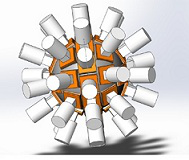
The γ-ray spectroscopy of 142Tb was performed by populating the high spin states in this nucleus by a fusion evaporation reaction 112Sn(35Cl, 2p3n)142Tb at 195 MeV of 35Cl-beam obtained from the Pelletron Linac Facility at TIFR, Mumbai. The γ-rays were detected using an array with eleven Compton-suppressed clover detectors. The 8.8 mg/cm2 thick 208Pb backed enriched 112Sn (99.6%) target of thickness 2.44 mg/cm2 was used to produce the residual nuclei.
The detailed analysis is in progress. The details of the experiment, interesting results and the interpretation of the level scheme will be presented.
References:
[1] Y. S. Chen et al., Phys. Rev. C 28, 2437 (1983).
[2] E. O. Podsvirova et al., Eur. Phys. J. A 21, 1 (2004).
[3] C. Scholey et al., Phys. Rev. C 63, 034321 (2001).
[4] P. J. R. Mason et al., Phys. Rev. C 79, 024318 (2009).
Primary author
Dr
H Pai
(Saha Institute of Nuclear Physics, HBNI, Kolkata-700064, India)
Co-authors
Prof.
A Goswami
(Saha Institute of Nuclear Physics, HBNI, Kolkata 700064, India)
Mr
Abraham T Vazhappilly
(Tata Institute of Fundamental Research, Mumbai)
Mr
B. S. Naidu
(Tata Institute of Fundamental Research, Mumbai)
Mr
Babra F. S.
(Tata Institute of Fundamental Research, Mumbai)
Dr
Balaram Dey
(Saha Institute of Nuclear Physics, HBNI, Kolkata 700064, India)
Dr
C.S. Palshetkar
(Tata Institute of Fundamental Research, Mumbai)
Dr
G Mukherjee
(Variable Energy Cyclotron Centre, 1/AF Bidhan Nagar, Kolkata 700064, INDIA)
Mr
Laskar Md. S. R.
(Tata Institute of Fundamental Research, Mumbai)
Ms
P Ray
(Saha Institute of Nuclear Physics, HBNI, Kolkata 700064, India)
Mr
R Banik
(Variable Energy Cyclotron Centre, 1/AF Bidhan Nagar, Kolkata 700064, INDIA)
Mr
R Donthi
(Tata Institute of Fundamental Research, Mumbai)
Prof.
R Palit
(Tata Institute of Fundamental Research, Mumbai)
Dr
S Bhattacharyya
(1Variable Energy Cyclotron Centre, 1/AF Bidhan Nagar, Kolkata 700064, INDIA)
Dr
S Biswas
(Tata Institute of Fundamental Research, Mumbai)
Mr
S Jadhav
(Tata Institute of Fundamental Research, Mumbai)
Dr
S Rajbanshi
(Department of Physics, Dum Dum Motijheel College, Kolkata 700074, India)
Mr
Sajad Ali
(Saha Institute of Nuclear Physics, HBNI, Kolkata 700064, India and)
Mr
Soumik Bhattacharya
(Variable Energy Cyclotron Centre, 1/AF Bidhan Nagar, Kolkata 700064, INDIA)